
The industrial cooperative carried out the research together with the Public University of Navarre (UPNA) and German multinational DEUTZ, one of its main customers. The results include a methodology for characterising its castings in a hydrogen atmosphere and an engine that accepts different fuels, either alone or blended.
After three years of work, Tafalla Iron Foundry (TIF) has completed its project aimed at converting internal combustion engines to run on hydrogen. The cooperative closes this stage with tangible results: its own method for assessing how its castings behave in the presence of this gas, and an engine adapted to run on it, either alone or combined with other fuels.
The initiative brought together all three links in the chain: UPNA and TIF on the research side, and DEUTZ as the manufacturer that integrates the parts into its engines. The German company joined the research agreement already in place between TIF and the university in early 2024, in what has been its first collaboration with an academic institution outside Germany. In addition to providing the engine under study, it contributed its technical documentation and advised the team throughout the testing. “For an engine manufacturer, the transition to hydrogen doesn’t start with combustion, but with materials. We need to know how they respond after hours in contact with this gas. This project provides the first data on components we already use,” DEUTZ said.
In the part of the project devoted to castings, TIF and UPNA’s Materials Department have established a procedure for characterising them in a hydrogen atmosphere. The study was carried out on 45 test specimens of three different types of cast iron, which were then charged with hydrogen by electrolysis or subjected to a controlled atmosphere to simulate the operating conditions of an engine.
Tensile, toughness and hardness tests, compared with those of hydrogen-free specimens, have provided an initial picture of how their mechanical properties evolve. This was reinforced by scanning electron microscopy (SEM), which shows at a microscopic scale how the gas affects the internal structure of the parts.
According to the scientific literature, contact with hydrogen can cause microcracks in these alloys. However, the project’s initial results show no significant differences in the mechanical properties of the castings after exposure. On the other hand, microscopic analysis did detect, after the most intensive charging, small internal pores in which the gas accumulates, so TIF and UPNA plan to extend the study in the future.
“We are closing the project with our own knowledge of how our castings behave when working with hydrogen. That is what allows us to support our customers in designing the engines of the future, rather than simply manufacturing their parts,” explains Atenea Romero, project manager at TIF and head of this initiative.
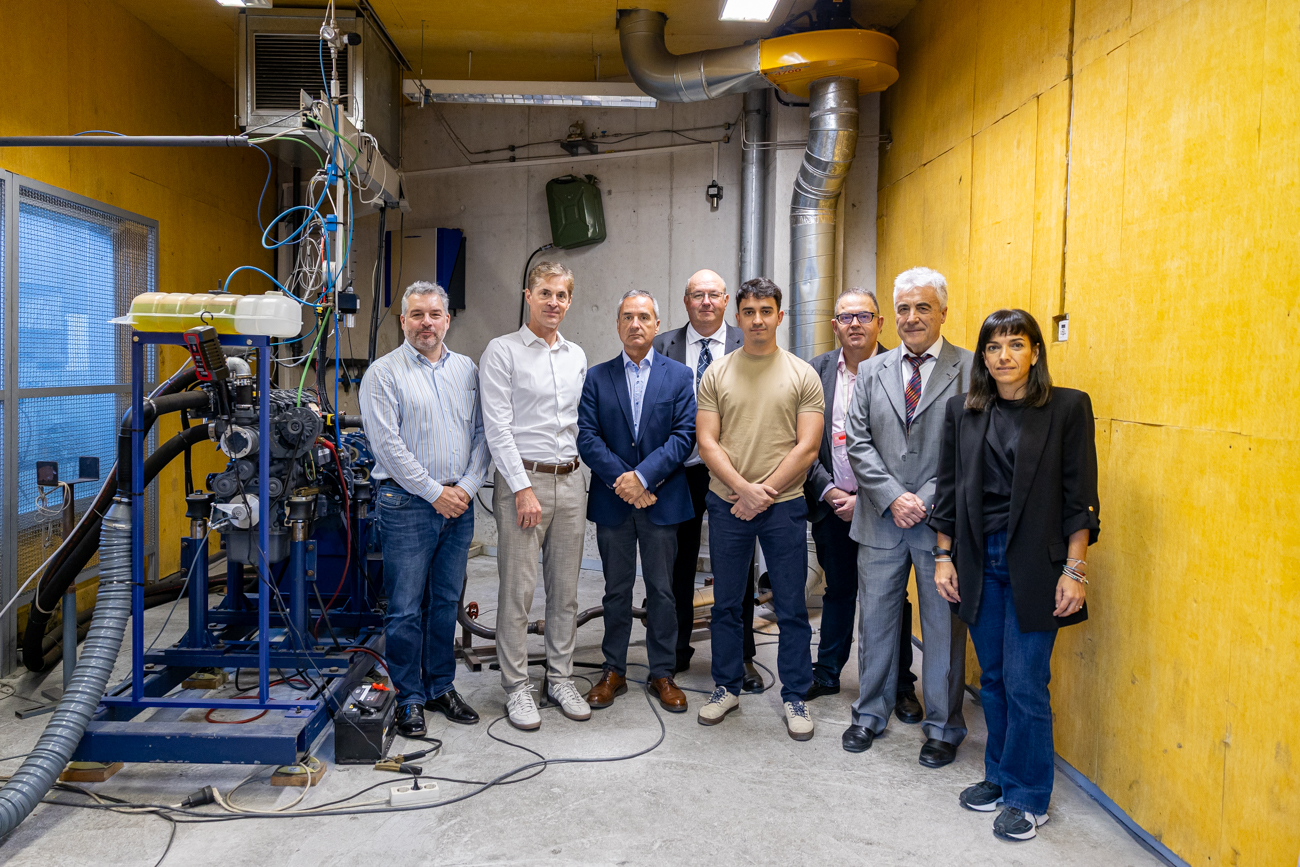
In parallel, UPNA’s hydrogen group, led by Pedro Diéguez, has transformed the industrial engine donated by DEUTZ, originally a petrol engine, so that it can also run on hydrogen or on a blend of both fuels. With hydrogen as the only fuel, emissions fall significantly, although power drops. To recover it, different combinations have been tested that keep emissions low while matching the performance of the conventional engine. The engine has also been modified to run on methanol and ethanol. New fuels are expected to be added in the future, turning it into a multi-fuel engine.
One of the most notable advances, led by UPNA’s hydrogen group, has been the control of abnormal combustion, or knocking, which is common with such a reactive fuel. To prevent it, the researchers developed their own programming that injects a small amount of petrol or water when the engine is about to knock. The university presented this work at the European Hydrogen Energy Conference (EHEC 2026), held in Seville last March and considered one of the sector’s leading European forums.
“Working with real engines and materials forces us to answer questions that industry needs to solve now. For the university, that is as valuable as it is for the company: it allows us to carry out research with direct application,” says Adrián Claver, from UPNA’s Materials Department.
The end of the project does not mean the end of the collaboration. TIF and UPNA plan to open new lines of work on materials, such as cyclic testing, which reproduces the repeated loads a part withstands over its service life, and tests on hydrogen engines in operation. “Applied research is now part of the way we work. It is what allows us to stay ahead: the questions we solve in the laboratory today are the ones our customers will ask us tomorrow,” Romero adds.


